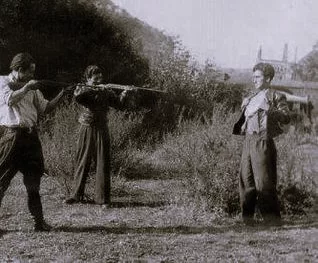
The revolt of the “Gypsy families camp”: episode 6/9 “The Heroic Act”

The revolt of the “Gypsy families camp”: episode 6/9 “The Heroic Act”

Battle story

The Revolt of the “Gypsy Family Camp”

Episode 6/9 : « The Heroic act »

By Pierre Chopinaud

The episodes in this series are adapted from a lecture delivered by Pierre Chopinaud on 16 May 2025 in Berlin for the European Roma Institute for Arts and Culture (Eriac).


(Previously…)

“We had begun to use history—our histories—to create the power we needed to bring about the change we were seeking and to give our own people the courage to take action.

Then, over the months and years that followed, we spread this story, like a gospel or glad tidings, among our friends in France and in other countries.”


 “

“The testimony of an eyewitness who witnessed the events at the age of ten while imprisoned in the camp.”

The next challenge was to establish the historical facts surrounding the revolt of 16 May 1944. No one had ever truly attempted to do so. We therefore began to search, to investigate. We even wrote a first book, Avava Ovava, together with our small group, which, besides Saimir Mile and myself, included the activist Anina Ciuciu and the very young historians Lise Foinseau and Valentin Merlin.

In that book, in a chapter entitled “Walpurgis Night,” I recount what happened on 16 May 1944, drawing on the evidence we had gathered up to that point. I also put forward an important hypothesis, one that I now invite historians and researchers to continue examining.

In addition to the account that Saimir Mile had heard a few years earlier from Hugo Hollenreiner—an eyewitness who had witnessed the revolt at the age of ten while imprisoned in the camp, and who maintained that his father, a German Sinto, had been one of its leaders—we discovered, in 2010, another trace of this story in Otto Rosenberg’s memoir, A Gypsy in Auschwitz, published in London in 1999.


“In 1940, at the age of thirteen, he was sent to forced labour—that is, into slavery—in an arms factory.”

In this book, Otto Rosenberg tells his own story. Born in 1927, he was interned at the age of nine, in 1936, together with his family, as a German Sinto, in the first concentration camp established by the Third Reich for Roma and Sinti: the Berlin-Marzahn camp.

Then, in 1940, at the age of thirteen, he was sent to forced labour—in other words, into slavery—in an arms factory. Two years later, he was caught carrying out acts of sabotage in the factory. He was fifteen years old. He was imprisoned.

His story bears a striking resemblance to that of Raymond Gurême, whose story I will tell after recounting what we know about the revolt of 16 May.

Otto Rosenberg spent four months in prison. On 14 May 1943, he was deported to the Gypsy Family Camp at Auschwitz II-Birkenau, namely section BIIe. He was then fifteen years old.

Section BIIe at Birkenau had opened in February 1943, three months before Otto’s arrival and two months after Himmler issued the decree known as the Auschwitz-Erlass, which ordered the implementation of the genocide of the Roma and Sinti.

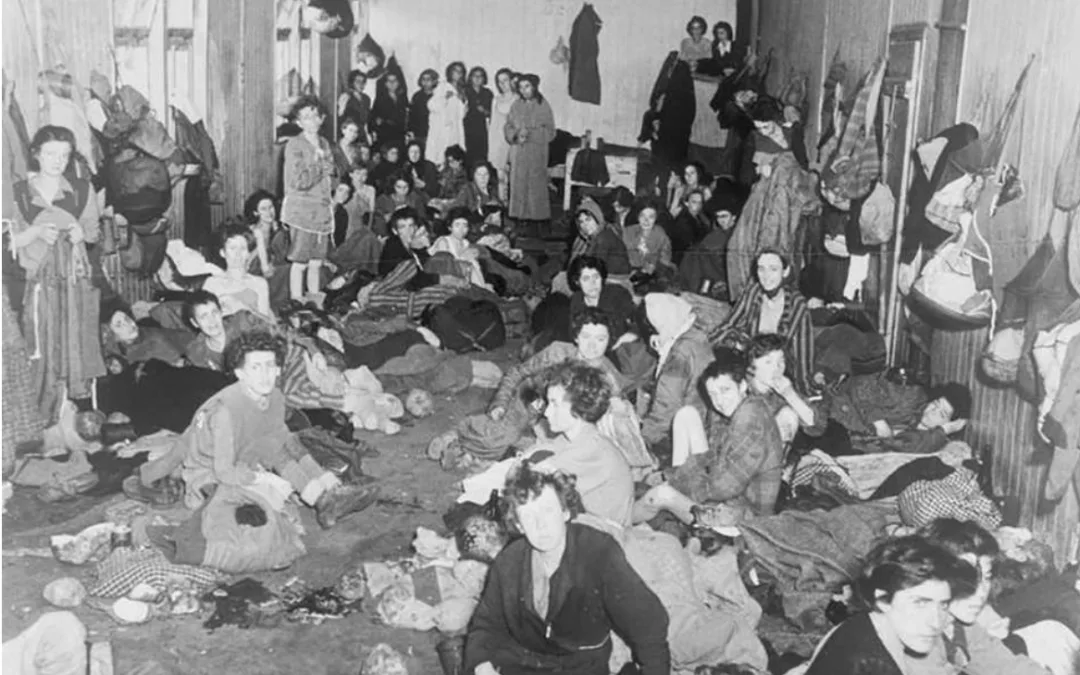
Unlike the other sections of the camp, where men and women were separated, section BIIe—the “Gypsy Family Camp”—kept entire families together. Up to 6,000 people were confined there at the same time, housed in 32 former horse stables, arranged in two rows of sixteen facing one another across a central avenue.


“Why, in these two camps, were men, women and children imprisoned together as families? It remains a mystery.”

In fact, there was another “Family Camp.” Slightly further down lay section BIIb, the Theresienstadt Jewish Family Camp.

Why, in these two camps, were men, women and children imprisoned together as families? It remains a mystery.

As for the Gypsy Family Camp, one hypothesis may be put forward. Within section BIIe stood the hospital laboratory where the Nazi criminal Joseph Mengele committed his infamous crimes. It was inside the Family Camp itself that pseudo-scientific racial experiments and observations were carried out on the prisoners. Perhaps this was why entire families had to be kept together.

But let us return to Otto Rosenberg, who was fifteen years old in May 1944. In his memoir, he explains that despite his young age, he was one of the participants in the revolt of 16 May. He recounts it in these words:


“We were all armed—with shovels, spades, hammers, pickaxes, hoes, pitchforks, our work tools, and whatever else people could lay their hands on. Everyone said: very well, if they want to round us up here, then we will make them pay the highest possible price for our lives.”

“I was to take my position on one side of the camp road opposite the sauna, and my cousin Oscar on the other.

The block elders told us:

‘When we give you the signal with the torches, you will run and knock at every block. They will know what to do.’

If the SS had seen us, they would have shot us on the spot. But they did not see us. When we saw the flashing signal, we ran, and when we knocked, the block elder immediately understood: ‘Aha, they’re here.’

We slipped back into our barracks. Then, shortly afterwards, Camp Commandant Schwarzhuber entered the camp with his men, dogs on leashes and machine guns. He inspected several blocks with his men.


“Senior Block Leader reporting: Block 7 occupied by 350 prisoners. Nothing to report!”

“He came briefly towards us. Apparently, all he wanted was to check the records. Spot checks.

But we knew what was really happening.

We were all armed—with shovels, spades, hammers, pickaxes, hoes, pitchforks, our work tools, and whatever else people could find. Everyone said: Very well, if they want to gather us here, then we will make them pay the highest possible price for our lives. We will not surrender ourselves into their hands. Perhaps we will manage to seize their machine guns; then, naturally, we will stand a better chance.

(…)

Then Schwarzhuber inspected a few more blocks before withdrawing with his troops exactly as he had arrived. He must have thought to himself: If we go through with this, it will descend into chaos. They will not give in. They will fight back.


Otto Rosenberg survived the genocide. After Birkenau, he was deported to the camps of Buchenwald, Dora, and Bergen-Belsen. After the war, he continued his struggle and became one of the leading figures in the movement for the civil rights of German Roma and Sinti.

In his account of the heroic act in which he himself took part, it becomes clear that he was acting within the framework of an organised plan…

(To be continued in the next episode…)


The revolt of the “Gypsy families camp”: episode 5/9 “Overturn history”

The revolt of the “Gypsy families camp”: episode 5/9 “Overturn history”

BATTLE STORY

The revolt of the “Gypsy families’ camp”

Episode 5/9 : « Overturn History »

By Pierre Chopinaud

The episodes of the series are based on a lecture given by Pierre Chopinaud on May 16, 2025 in Berlin for the European Roman Institute for Art and Culture  (Eriac).


(previously…)

So we needed, and you still need, to find a way to give people the courage to take action; we needed to develop, through leadership, their agency, as they say in academia. Now, among the leadership techniques used in radical political organizations to motivate people to act is the power of storytelling, which is the inherent power of speech, a power available to anyone with a tongue, a mind, and a heart. Listen to Martin Luther King’s speeches, listen to what makes your heart vibrate, what makes you weep, not with sadness, but with the joy felt by someone about to commit themselves.


 “

In 1943, Hugo was ten years old. It was from his own lips, 70 years later, that we first heard the story of the Roma and Sinti people who had organized an act of insurrection on May 16, 1944, in Auschwitz-Birkenau.

So, in 2010, my friend Saimir and I decided that, in order to give people the courage to act politically, we needed to reshape the narrative that surrounded us. It was then that Saimir, who was already older, remembered two things, or rather, two stories:

The first was the story of Hugo Hollenreiner, which he rediscovered deep in his memory, just as he remembered hearing it from him a few years earlier. Hugo, now deceased, was nearly 70 years old at the time. He was a Sinti of German nationality, born in 1933, the very year Adolf Hitler came to power. Thinking it would protect them, as if to show their loyalty to the German nation to which they felt they belonged, his parents had given him Adolf as a middle name.

But it was all in vain. Following the anti-Roma decree of December 16, 1942, the “Auschwitz erlass,” promulgated by Himmler, which ordered the racial extermination of Roma, Manouche, Sinti, and Travellers, Hugo and his family were arrested and deported in early 1943 to the “Gypsy family camp” at Auschwitz II-Birkenau.

Hugo’s father had been a soldier in the German army before being deported. After the decree, he was dismissed from the army and his citizenship was revoked. He was a young, robust, and courageous man. In 1943, Hugo was ten years old. It was from his own words, 60 years later, that we first heard the story of the Roma and Sinti who had organized an uprising in Birkenau. Hugo remembered it. He had seen it with his own eyes. His father had been a leader and a organizer of this revolt. After May 16, 1944, his father and the other leaders, along with their families, were transferred to other camps. For Hugo, his brothers and sisters, and his father, it was Bergen-Belsen.


we had the story we were going to tell, we had the fact on which to base ourselves to overturn history, to transform it from a story of only suffering and passivity, of fear and horror, into a story of action and courage, of heroism and beauty.


There it was, we had the story we were going to tell, the fact on which to base our narrative, to transform it from a story of suffering and passivity, of fear and horror, into a story of action and courage, of heroism and beauty.

Then, Saimir remembered a second story. He remembered a little man he had heard at one of those tedious ceremonies of tribute and honor in the lobby of Paris City Hall, in the presence of self-important officials, a few representatives of isolated organizations, and in the absence of anyone from the community. He vaguely remembered that amidst the indifference, the boredom, the hypocrisy that accompanies this kind of ceremony, the little man and his story had struck him. It took him several days to search his memory, his email inbox, his papers, for his name.

It was Raymond Gurême.

“We had found Raymond Gurême. He was waiting for us, sitting on the steps of his son-in-law’s small stilt house, under a yellow lightbulb that illuminated his little hat in the night.”


After a few phone calls, we managed to get in touch with him and arrange to meet him at his home, on the southern edge of the Paris region, one evening in March 2010. We arrived; it was already dark, and we got lost several times. It was on the edge of a forest. For miles, on either side of the paths and roads, there were hundreds and hundreds of caravans. We had an address and a GPS. But even the GPS was completely lost. The Gurême family are a family of traveling Romani and circus performers who live in caravans but who gave up traveling decades ago because this way of life has been made impossible by the repressive policies of the French state. The brothers, the sisters, then the children, the cousins, the relatives, successively bought plots of land in this small corner of the southern Paris region and parked their caravan there, where it has remained ever since. Why this particular spot? We were about to find out.

After wandering for a long time among the paths, dogs, and caravans, without light – the edges of the forest were unlit – we found Raymond Gurême. He was waiting for us, sitting on the steps of his son-in-law’s small stilt house, under a yellow bulb that illuminated his little hat in the night, amidst a cloud of smoke from the small tobacco cigarette that would remain in his mouth all evening.

“We chose the day of the revolt in the “Gypsy family camp of Auschwitz” that Hugo Hollenreiher had told us about, May 16th, we created a scene, and we set it up in front of the great basilica of Saint-Denis, in the north of Paris.”


First, he pointed to a hill in the night above the forest and said, “Do you see that dark mass up there? That’s where I was imprisoned during the war in the Lynas-Montheléy concentration camp with my family. I was 14 years old.”

Years later, he returned to settle down, and behind him, his entire family and community, at the foot of the place that had been the site of their suffering. Why, until his death, may he rest in peace, he never knew.

But that evening, until late into the night, he told us the story of his entire life. The misfortunes, the battles, the resistance, the love, the funny moments. I still remember seeing that night as a vast adventure film, with the real-life hero sitting before me: a man of immense courage and love, despite his small stature and the physical hardships he had endured. How could so much life force be contained in such a small body? It’s a question I still ask myself today.

The fact remains that we had our story and we had our man.

We chose the day of the revolt at the “Gypsy family camp of Auschwitz,” which Hugo Hollenreiher had told us about, May 16th. We created a stage, set it up in front of the great Basilica of Saint-Denis, in northern Paris, the place where, as I mentioned earlier, it is recorded that the Roma, the Manouche, the Sinti were first mentioned in French history, and on the stage we placed Raymond Gurême and his story. It was May 16, 2010: we had created the first Romani Resistance Day.

“We had begun to use history, our stories, to create the power we needed to achieve the change we sought and to give our people the courage to take action.”

We did it with only the resources we and the people around us had.

We began using history, our stories, to create the power we needed to achieve the change we sought and to give our people the courage to take action.

Then, in the months and years that followed, we spread this story, like good news, to our friends in France and other countries.


(To be continued in the next episode…)

The revolt of the “Gypsy families camp”: episode 4/9 “Lives that are worthless?

The revolt of the “Gypsy families camp”: episode 4/9 “Lives that are worthless?

battle story

The revolt of the “Gypsy families’ camp”

Episode 4/9: “Lives that are worthless?”

BY Pierre Chopinaud

The episodes of the series are based on a lecture given by Pierre Chopinaud on May 16, 2025 in Berlin for the European Roman Institute for Art and Culture (Eriac).


(previously…)

Similarly, for European states to recognize the genocide perpetrated against Roma, Manouche, Sinti, Yenish, and Travellers during the Second World War, if there were still time, arguments based on morality or responsibility are insufficient. What we need is the power to compel them to do so.

And the campaign for genocide recognition that I am developing in France is actually less about obtaining this recognition than about creating the power structure that will be able to act in the next crisis. Because, once again, what we need, then as now, in the dangerous new world we are entering, is the power to act collectively and resist.

That is why we need stories like the revolt of the Roma family camp on May 16, 1944.


 “The French government’s policy towards them was shameful and meant only one thing: your lives are worthless”


How did this story come about?
When I returned from Suto Orizari, to Paris, driven by the imperative to act, I met with Roma activists and met the man who would become my comrade in many battles: Saimir Mile. He had just founded the organization La Voix des Rroms (The Voice of the Roma).
In Paris in 2010, many people were arriving from Bulgaria and Romania and settling in small shantytowns around the city. The French government’s policy towards them was shameful and meant only one thing: your lives are worthless.

As we were the only active and recognized Roma organization in Paris, people turned to us for help.


“The full power of a state against us, using the forces of its law, its police, its capacity to spread racial hatred.”

It was a difficult fight, facing very powerful forces, the full power of a state against us, using the forces of its law, its police, its capacity to spread racial hatred in society to legitimize its actions. And on top of that, it destroyed people’s homes, used police brutality against women and children, forcibly put people on charter flights, separating children from parents. It was heartbreaking, shameful, revolting. It was a bit like Trump in 2025, 15 years earlier.


We were like the shepherd boy David facing the mighty giant Goliath. And we knew that the only resources we could count on were those we had and those the people around us had.


We said it at the time. Faced with this authoritarian and pre-fascist state power, we were small. Although we sometimes won small victories on the ground, we most often felt powerless and exhausted. Even the condemnations of France by the European Commission and the UN had no effect on the reality. We were like the little shepherd David facing the mighty giant Goliath. And we knew that the only resources we could count on were those we had and those of the people around us: precisely those who needed, for their lives, the change we were trying to bring about together.


“That’s what the story of May 16th is about: the power we all need together is not outside of ourselves, it’s within our people.”

We had only one way out, and that was the path described by the master of radical political organizing, Dr. Martin Luther King Jr.: to transform the meager resources at our disposal into the weapons we needed to achieve the change we sought. In short: we needed to give suffering people the courage to take action. For—and this is what the story of May 16th is about—the power we all need together is not outside of ourselves; it is within our people. It is with them that we must create it, yesterday as now. It is in the hearts and hands of those who, like us, suffer from this reality that the power to transform it resides.


“The power of storytelling is the inherent power of speech, which is available to anyone who possesses a tongue, a head, and a heart.”

So we needed, and you still need, to find a way to give people the courage to take action; we needed to develop, through leadership, their agency, as they say in academia.

Now, among the leadership techniques used in radical political organizations to motivate people to act is the power of storytelling, which is the inherent power of words, a power available to anyone with a tongue, a mind, and a heart.
Listen to Martin Luther King’s speeches, listen to what makes your heart resonate, what makes you weep, not with sadness, but with the joy felt by someone about to commit themselves.

 (La suite dans le prochain épisode….)

The revolt of the “Gypsy families camp”: episode 3/9 “the measure of the wound”

The revolt of the “Gypsy families camp”: episode 3/9 “the measure of the wound”

BATTLE STORY

The revolt of the “Gypsy families camp”: episode 3/9 “Lives that are worthless?”

bY Pierre Chopinaud

The episodes of the series are based on a lecture given by Pierre Chopinaud on May 16, 2025 in Berlin for the European Romani Institute for Art and Culture (Eriac).


(Previously…)

“What was now certain was that the story in which I had grown up, the story in which I had learned I was like a character, the story in which my conscience was formed, the story whose moral dictates that if human dignity dies in one person, it dies for all humanity, because all lives equally deserve dignity, the story whose principles and values ​​state that all human lives are equal in dignity and have the right to security and happiness, especially if they are exposed to political hatred—this story would lose all meaning if I didn’t take action. By doing what? I didn’t yet know. Except perhaps to strive, with others, using the powers I possessed, and which I still needed to discover (what can one do at 18?), to make reality resemble the ideal we dream of. To make the world coincide.” as it should be with the world as it really is, as the master of radical political organizing, Martin Luther King, said when describing his vision: “I had a dream”


 “The wound that separates reality and the ideal cannot be healed with the humanitarian bandage of social aid, nor with moral sermons; it must be healed with the instrument of power.”

The gap between the ideal and reality is the measure of the wound afflicting the conscience. It is through commitment and action that reduces this gap that the one whose conscience suffers heals their wound.

But it is not, according to the precepts of Dr. King’s radical political organization, with the humanitarian bandage of social aid, nor with moral sermons, that one heals the wound that separates reality and the ideal; it is through the instrument of power. This is what I will explain by recounting the story of the Romani resistance and May 16, 1944.

Something that could have happened twenty years ago meant that reality was not what I see, that reality—mine, yours—more closely resembled our ideal, the world we dream of where all lives matter, where all lives are equally worthy of mourning; One thing that could have prevented a 27-year-old Roma woman, among my loved ones and those who matter to me, from being gunned down in cold blood by hunters sympathetic to Marine Le Pen, with her unborn son in her womb, as happened in June 2024 in the Jura region of France. One thing that could have prevented the execution of young Angelo, 37, brother of my friend Aurélie Garand, a young Yenish woman living in the city of Blois in central France, on March 17, 2017, by French army special forces because these forces, in order to combat terrorism, conduct training exercises on “Gypsies.” One thing that could have prevented my friend Sue-Ellen Demestre’s mother, a Roma woman and voyeur, from dying because of environmental racism, because she was forced to live on a reception site between a factory and a concrete mixer, is the recognition by European states of the genocide perpetrated against Roma, Manouche, Sinti, Gitans, Yenish, and Travellers during the Second World War. This thing could have prevented Roma people in Metrovica from dying until 2019 under the responsibility of the UN, after the nationalists of the time had murdered their loved ones and burned their homes.


“Today in Europe, while the global far right is coming to power everywhere, recognition of the genocide is lacking”

It was a difficult fight, facing very powerful forces, the full power of a state against us, using the forces of its law, its police, its capacity to spread racial hatred in society to legitimize its actions. And on top of that, it destroyed people’s homes, used police brutality against women and children, forcibly put people on charter flights, separating children from parents. It was heartbreaking, shameful, revolting. It was a bit like Trump in 2025, 15 years earlier.


“Anti-Gypsyism is one of the paths that the new fascism is forging to reach its end.”


Why this? Because when states acknowledge that a group of men, women, and children was treated in the past as if they did not belong to the human community, as if their ignoble and anonymous murder were the killing of an animal, this acknowledgment restores a name and a burial to the deceased, gives them back a measure of their dignity, and reintegrates them, through the remembrance of their name and the condemnation of the crime of which they were victims, into common humanity and into history. By restoring this dignity to the dead, it tells their descendants that their lives matter today. And that they must be protected, because they are particularly vulnerable to the political ills that chronically afflict our societies, the ills of racial hatred that chronically afflict nation-states, which then threaten the security and lives of citizens belonging to racial minorities by saying: your lives don’t matter, your dead will not be mourned.

Today in Europe, while the global far right is coming to power everywhere, recognition of the genocide is lacking.


“What we need, then as now, in the dangerous new world we are entering, is the power to act collectively and resist.”

I repeat: is there still time? In France, we are just moments before the far right returns to power. Isn’t it already too late? It’s there in Italy, in Hungary, we can say, in America, let’s not even go there, it’s stronger than ever in Germany, in Spain. It has always been both too late and still time. In any case, there is an urgent need for action: the value of our lives and the lives of those close to us depends on it. Our security. There is an urgent need to build power. Because soon, we will only be able to rely on ourselves and our allies.

Similarly, for European states to recognize the genocide perpetrated against Roma, Manouche, Sinti, Yenish, and Travellers during the Second World War, if there were still time, arguments based on morality or responsibility are insufficient. What we need is the power to compel them to do so.

And the campaign for genocide recognition that I am developing in France is actually less about obtaining this recognition than about creating the power structure that will be able to act in the next crisis. Because, once again, what we need, then as now, in the dangerous new world we are entering, is the power to act collectively and resist.

That is why we need stories like the revolt of the Roma family camp on May 16, 1994.

(To be continued in the next episode…)

The revolt of the “Gypsy families camp”: episode 2/9 “The world as it really is”

The revolt of the “Gypsy families camp”: episode 2/9 “The world as it really is”

Battle STORY

The revolt of the “Gypsy families’ camp”

Episode 2/9: “The world as it really is”

By Pierre Chopinaud

The episodes of the series are based on a lecture given by Pierre Chopinaud on May 16, 2025 in Berlin for the European Romani Institute for Art and Culture (Eriac).


(Previously…)

“The stories I heard, and that you surely have heard since childhood—the stories and grand pronouncements that form the foundation of contemporary European civilization—can be summed up in a slogan, in a moral: ‘Never again!’ Never again should children, men, and women be placed in the state of distress and indignity into which they were subjected by racist and nationalist hatred during the Second World War. Yet here, somewhere in Europe, the children, women, and men of a national minority had been almost entirely driven from the land, from the country to which they belonged, by racist and nationalist hatred, and those who remained were left to die under the care of the United Nations, the very organization tasked with protecting them, in a state of organized collective weakness that had no equivalent in Europe since the Second World War.”


 “Today, the Roma minorities of Ukraine are at risk of being erased from the present and past of the nation to which they belong.”

“Never again?” That, I’ve heard since childhood, is the moral of European history. Yet here and now, before my very eyes, it was still happening. It was still happening, especially for children, women, and men whose ancestors, 60 years ago, were victims of the genocide perpetrated by the racial hatred of the Nazi German state and its allied and collaborating states.

I want to emphasize that, 20 years later, today it’s still happening for the Roma minority in Ukraine, both in the eastern regions invaded by the Russian army and in the still-protected central and western territories, who are at risk of being erased from the present and past of the nation to which they belong.

.

“Does this mean that Europe was still suffering from the same ill? Was the moral of contemporary European history a bad fable? “


As an outsider, the situation I witnessed called into question my own history, my own identity as a Frenchman, as a European, the principles and values ​​in which I had been raised. How is it possible that here in Europe, men, women, and children whose ancestors were victims, just like the Jewish men, women, and children of Europe, of the immense crime in whose memory modern Europe was rebuilt, could find themselves thus driven from their land, murdered, abandoned, victims of the states to which they belong, under the responsibility of the United Nations, and in the indifference of the consciences of the people?

How was it possible that men, children, and women—whose parents’ and grandparents’ bodies had, 60 years earlier, been reduced to lives deemed worthless—could, with the widespread consent of elites and the people, be rejected 60 years later from the condition of humanity and the dignity that, as a natural right, belongs to them?

Does this mean that Europe was still suffering from the same affliction? Was the moral of contemporary European history a bad fable?

How can we look at this question now, 20 years later, when far-right and fascist movements are returning to power, one after another, in European countries?


“To make the world as it should be coincide with the world as it actually is, as the master of radical political organizing, Martin Luther King, said when he described his vision”


For me, the moral of the little stories I’d heard there 20 years ago, when I was 18, was that my life had to take a certain direction. I didn’t know exactly which one yet. But what was now certain was that the story I’d grown up in, the story in which I’d learned I was like a character, the story in which my conscience was formed, the story whose moral says that if human dignity dies in one person, it dies for all of humanity, because all lives equally deserve dignity, the story whose principles and values ​​say that all human lives are equal in dignity and have the right to security and happiness, especially if they are exposed to political hatred—this story would lose all meaning if I didn’t take action. By doing what? I didn’t know yet. Otherwise, I would strive, along with others, using the powers I possessed, and which I still needed to discover (what can one do at 18?), to make reality resemble the ideal we dream of. To make the world as it should be coincide with the world as it truly is, as the master of radical political organization, Martin Luther King, said when he described his vision: I had a dream.

(To be continued in the next episode…)

Privacy Overview

This website uses cookies so that we can provide you with the best user experience possible. Cookie information is stored in your browser and performs functions such as recognising you when you return to our website and helping our team to understand which sections of the website you find most interesting and useful.