The revolt of the “Gypsy families camp”: episode 6/9 “The Heroic Act”
Battle story
The Revolt of the “Gypsy Family Camp”
Episode 6/9 : « The Heroic act »
By Pierre Chopinaud
The episodes in this series are adapted from a lecture delivered by Pierre Chopinaud on 16 May 2025 in Berlin for the European Roma Institute for Arts and Culture (Eriac).
(Previously...)
“We had begun to use history—our histories—to create the power we needed to bring about the change we were seeking and to give our own people the courage to take action.
Then, over the months and years that followed, we spread this story, like a gospel or glad tidings, among our friends in France and in other countries.”
"
“The testimony of an eyewitness who witnessed the events at the age of ten while imprisoned in the camp.”
"
The next challenge was to establish the historical facts surrounding the revolt of 16 May 1944. No one had ever truly attempted to do so. We therefore began to search, to investigate. We even wrote a first book, Avava Ovava, together with our small group, which, besides Saimir Mile and myself, included the activist Anina Ciuciu and the very young historians Lise Foinseau and Valentin Merlin.
In that book, in a chapter entitled "Walpurgis Night," I recount what happened on 16 May 1944, drawing on the evidence we had gathered up to that point. I also put forward an important hypothesis, one that I now invite historians and researchers to continue examining.
In addition to the account that Saimir Mile had heard a few years earlier from Hugo Hollenreiner—an eyewitness who had witnessed the revolt at the age of ten while imprisoned in the camp, and who maintained that his father, a German Sinto, had been one of its leaders—we discovered, in 2010, another trace of this story in Otto Rosenberg's memoir, A Gypsy in Auschwitz, published in London in 1999.
“In 1940, at the age of thirteen, he was sent to forced labour—that is, into slavery—in an arms factory.”
In this book, Otto Rosenberg tells his own story. Born in 1927, he was interned at the age of nine, in 1936, together with his family, as a German Sinto, in the first concentration camp established by the Third Reich for Roma and Sinti: the Berlin-Marzahn camp.
Then, in 1940, at the age of thirteen, he was sent to forced labour—in other words, into slavery—in an arms factory. Two years later, he was caught carrying out acts of sabotage in the factory. He was fifteen years old. He was imprisoned.
His story bears a striking resemblance to that of Raymond Gurême, whose story I will tell after recounting what we know about the revolt of 16 May.
Otto Rosenberg spent four months in prison. On 14 May 1943, he was deported to the Gypsy Family Camp at Auschwitz II-Birkenau, namely section BIIe. He was then fifteen years old.
Section BIIe at Birkenau had opened in February 1943, three months before Otto's arrival and two months after Himmler issued the decree known as the Auschwitz-Erlass, which ordered the implementation of the genocide of the Roma and Sinti.
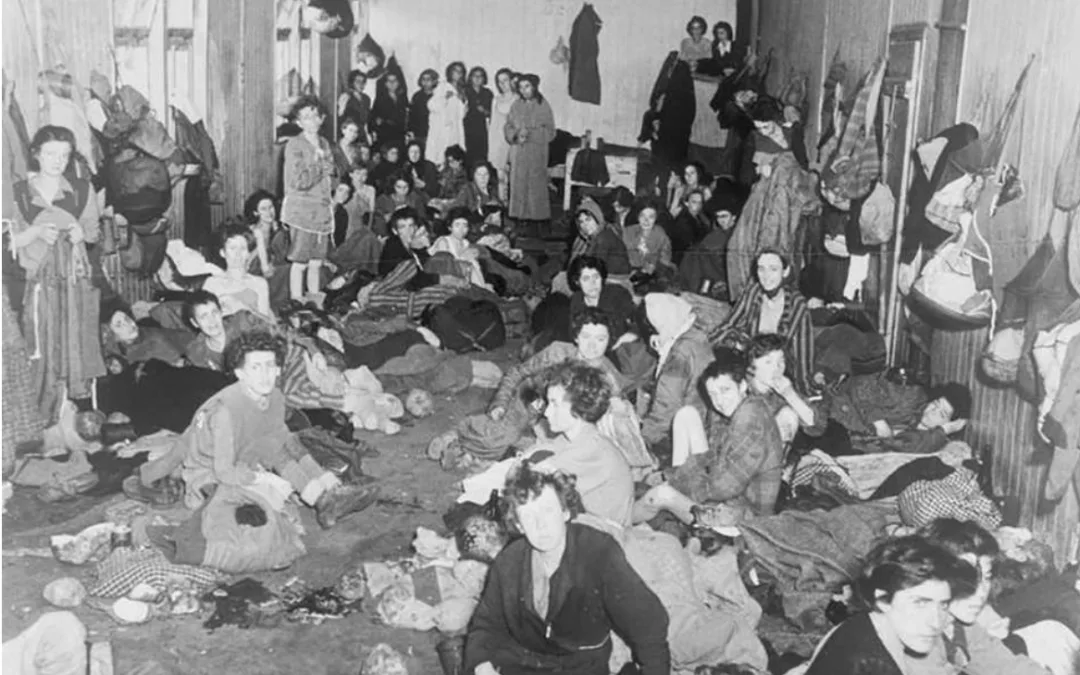
Unlike the other sections of the camp, where men and women were separated, section BIIe—the "Gypsy Family Camp"—kept entire families together. Up to 6,000 people were confined there at the same time, housed in 32 former horse stables, arranged in two rows of sixteen facing one another across a central avenue.
“Why, in these two camps, were men, women and children imprisoned together as families? It remains a mystery.”
In fact, there was another "Family Camp." Slightly further down lay section BIIb, the Theresienstadt Jewish Family Camp.
Why, in these two camps, were men, women and children imprisoned together as families? It remains a mystery.
As for the Gypsy Family Camp, one hypothesis may be put forward. Within section BIIe stood the hospital laboratory where the Nazi criminal Joseph Mengele committed his infamous crimes. It was inside the Family Camp itself that pseudo-scientific racial experiments and observations were carried out on the prisoners. Perhaps this was why entire families had to be kept together.
But let us return to Otto Rosenberg, who was fifteen years old in May 1944. In his memoir, he explains that despite his young age, he was one of the participants in the revolt of 16 May. He recounts it in these words:
“We were all armed—with shovels, spades, hammers, pickaxes, hoes, pitchforks, our work tools, and whatever else people could lay their hands on. Everyone said: very well, if they want to round us up here, then we will make them pay the highest possible price for our lives.”
“I was to take my position on one side of the camp road opposite the sauna, and my cousin Oscar on the other.
The block elders told us:
‘When we give you the signal with the torches, you will run and knock at every block. They will know what to do.’
If the SS had seen us, they would have shot us on the spot. But they did not see us. When we saw the flashing signal, we ran, and when we knocked, the block elder immediately understood: ‘Aha, they're here.’
We slipped back into our barracks. Then, shortly afterwards, Camp Commandant Schwarzhuber entered the camp with his men, dogs on leashes and machine guns. He inspected several blocks with his men.
“Senior Block Leader reporting: Block 7 occupied by 350 prisoners. Nothing to report!”
“He came briefly towards us. Apparently, all he wanted was to check the records. Spot checks.
But we knew what was really happening.
We were all armed—with shovels, spades, hammers, pickaxes, hoes, pitchforks, our work tools, and whatever else people could find. Everyone said: Very well, if they want to gather us here, then we will make them pay the highest possible price for our lives. We will not surrender ourselves into their hands. Perhaps we will manage to seize their machine guns; then, naturally, we will stand a better chance.
(...)
Then Schwarzhuber inspected a few more blocks before withdrawing with his troops exactly as he had arrived. He must have thought to himself: If we go through with this, it will descend into chaos. They will not give in. They will fight back.”
Otto Rosenberg survived the genocide. After Birkenau, he was deported to the camps of Buchenwald, Dora, and Bergen-Belsen. After the war, he continued his struggle and became one of the leading figures in the movement for the civil rights of German Roma and Sinti.
In his account of the heroic act in which he himself took part, it becomes clear that he was acting within the framework of an organised plan...
(To be continued in the next episode...)